

On September 3, 2026, the autonomous driving industry reached a functional divergence point between London and Austin. In London, Wayve initiated a service using a Ford Mustang Mach-E guided by a neural network that operates without high-definition mapping, while in Austin, Tesla began commercial operations of its pedal-less Cybercab, triggering an immediate audit from the National Highway Traffic Safety Administration.
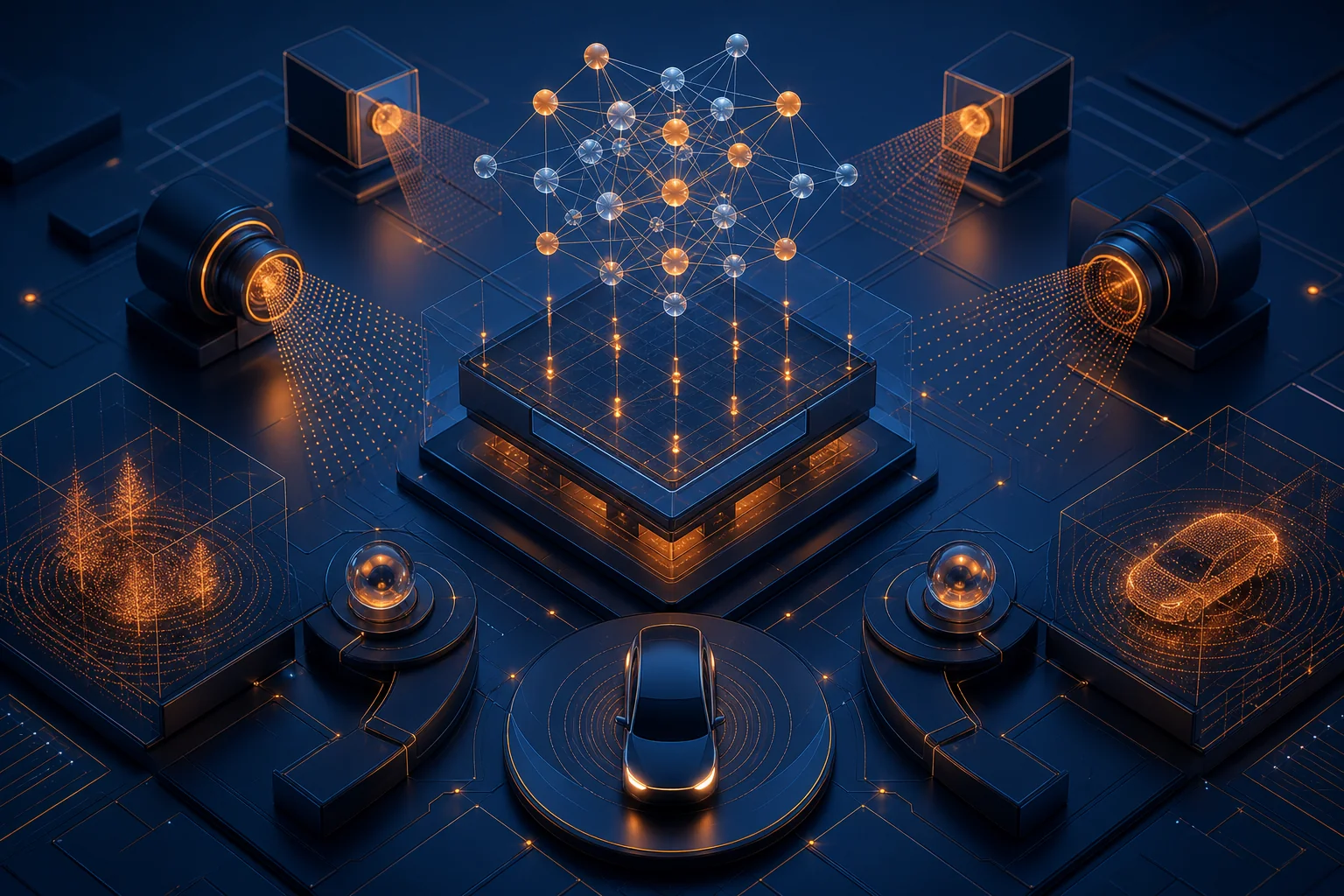
Traditional autonomous vehicle stacks rely on a modular pipeline where perception, prediction, planning, and control operate as distinct, hand-coded stages. This architecture allows engineers to isolate bugs to specific modules, but it creates information bottlenecks where each interface discards data that might be critical for downstream decision-making. End-to-end systems eliminate these hand-built interfaces by training a single model to map raw sensor data directly to vehicle trajectories.
Vision-Language-Action models represent the current state of this evolution, incorporating linguistic backbones to improve reasoning capabilities. NVIDIA’s 10-billion-parameter Alpamayo 1, deployed in the Mercedes-Benz CLA, exemplifies this shift toward supervised learning systems. These models learn from vast datasets of driving video, effectively replacing thousands of lines of explicit logic with learned behaviors.
Debugging these neural drivers presents a fundamental challenge because they lack traditional breakpoints or interpretable code paths. Developers must instead rely on reweighting training data or adding new examples, a process that risks degrading previously stable behaviors. NVIDIA attempts to mitigate this through a Chain of Causation, which provides a reasoning trace, though research indicates that explanation consistency does not guarantee trajectory accuracy.
Testing methodologies are also migrating toward synthetic environments to address the risks of real-world training. Wayve utilizes its 15-billion-parameter GAIA-3 generative world model to simulate near-miss scenarios that are too dangerous for physical testing. This approach creates a recursive validation loop where one neural network is tasked with evaluating the performance of another, a method currently undergoing scrutiny by academic and government partners.
Safety redundancy has not been abandoned but rather relocated to supervisory layers. Systems like the NVIDIA Halos safety platform wrap the primary neural driver in a set of verifiable guardrails that operate independently of the learned model. This hybrid approach acknowledges that while the primary driving logic may be a black box, the system must still adhere to rigid, deterministic safety constraints.
Regulatory bodies are shifting their focus from inspecting internal code to evaluating holistic safety cases. The UN’s WP.29 forum has adopted global regulations that prioritize evidence-based safety management over specific architectural requirements. This framework places the burden of proof on manufacturers to demonstrate that their systems perform at least as well as a competent human driver, regardless of the underlying software structure.
The current investigative focus of the National Highway Traffic Safety Administration highlights the tension between manufacturer claims and third-party verification. Regulators are increasingly scrutinizing the statistical foundations of safety claims, particularly for systems that rely exclusively on cameras. This skepticism is intensified by the ongoing engineering analysis of Tesla’s Full Self-Driving behavior in low-visibility conditions, where the lack of redundant sensor modalities complicates safety validation.
Waymo continues to operate at scale by maintaining a different architectural philosophy that integrates lidar and radar alongside cameras and high-definition maps. While Waymo also utilizes foundation models trained end-to-end, its reliance on diverse sensor modalities provides a cross-check mechanism that camera-only systems currently lack. The industry remains divided on whether the cost of mapping and additional sensors is a necessary trade-off for the reliability required in diverse operational environments.
The future of autonomous driving will likely be defined by the success of these competing validation strategies. As neural networks become more pervasive, the ability to provide verifiable evidence of safety will determine which systems move from testing to widespread deployment. Future milestones will center on the results of ongoing federal audits and the long-term performance data of map-less versus map-dependent navigation systems.