

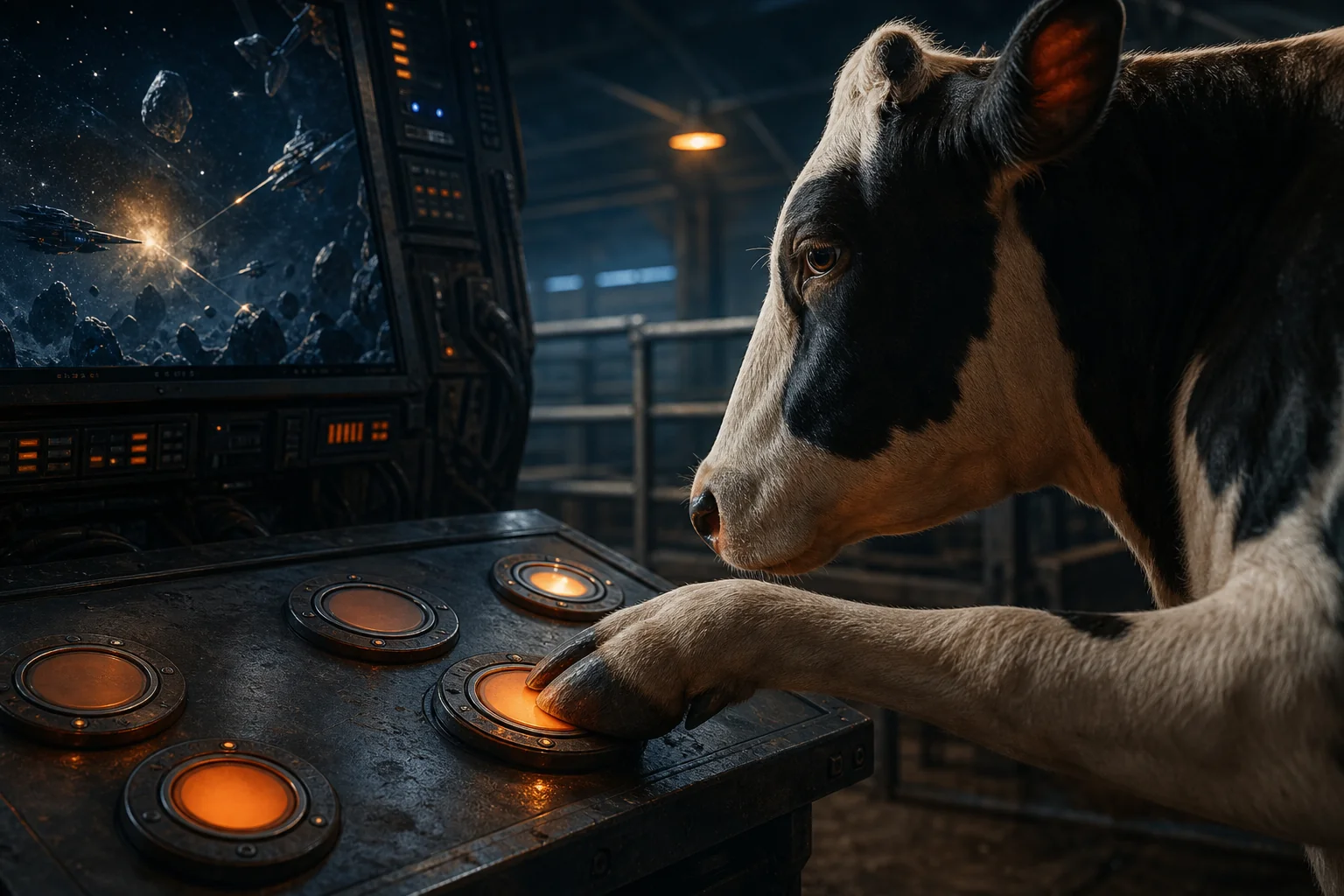
A bovine pilot identified as FC CapitalCowPilot is currently navigating the complex virtual economy of EVE Online through a custom-built hardware interface designed by Fenris Creations. This experimental setup, which debuted on September 2, 2026, utilizes a series of large, pressure-sensitive, cow-proof buttons mapped to specific in-game functions.
The engineering team at Fenris Creations constructed a physical enclosure that allows the animal to interact with the game environment through natural movement. Each button in the pen corresponds to a specific input command, enabling the cow to perform actions within the game client without human intervention. The system relies on a translation layer that maps physical switch closures to keyboard or mouse signals recognized by the EVE Online software architecture, utilizing a microcontroller to convert analog mechanical pressure into digital HID inputs that the game engine processes as standard peripheral commands.
Technical implementation focuses on durability and signal reliability, given the unpredictable nature of the input source. The buttons are reinforced to withstand significant force, ensuring that the hardware remains operational despite the physical intensity of the user. By integrating these mechanical switches with the game’s input API, the developers have successfully bypassed traditional human-centric control schemes.
The pilot is currently managing a public mining fleet within the Jouvulen system, a high-security zone that minimizes the risk of catastrophic loss during the testing phase. This environment allows the development team to observe the efficacy of the interface while maintaining a stable, low-stakes operational baseline. The choice of mining operations highlights the ability of the system to execute repetitive, command-based tasks effectively.
Open-world connectivity allows other players to join the fleet, creating a unique collaborative dynamic between human participants and the bovine operator. The system does not rely on automated scripts or artificial intelligence, but rather on the direct physical input of the animal. This distinction is critical for evaluating the responsiveness of the hardware in a live, multiplayer environment.
According to a report by Shacknews, the team is actively monitoring the stream to ensure the hardware maintains connectivity throughout the session. This oversight confirms that the project remains a manual, physical interaction rather than an automated simulation. The data gathered from these sessions provides insight into how non-traditional inputs affect server-side game state updates.
The significance of this experiment lies in the intersection of mechanical engineering and virtual world participation. By creating a bridge between the physical world of the cow and the digital world of the capsuleer, the engineers have expanded the definition of an input device. This setup forces a re-evaluation of how game clients interpret user intent and execute commands in real-time.
Stakeholders in the gaming and hardware sectors may view this as a proof-of-concept for specialized accessibility tools. While the application is currently recreational, the underlying technology demonstrates how custom hardware can facilitate interaction for users with non-standard physical requirements. The success of the interface suggests that game systems are more flexible than initially assumed regarding input source variety.
The experiment continues to operate in the Jouvulen system, with developers tracking the interaction between the physical hardware and the game’s server-side logic. Observers are watching for potential latency issues or command collisions that might occur during high-traffic periods in the game world. This ongoing trial will conclude once the team has gathered sufficient data on the durability and responsiveness of the cow-proof input system.
Future observations will focus on the long-term reliability of the button array and the consistency of the bovine pilot’s performance. The team at Fenris Creations intends to monitor the fleet’s output and the hardware’s structural integrity throughout the duration of the livestream. Any technical degradation or unexpected input patterns will provide data for refining future iterations of the interface.