

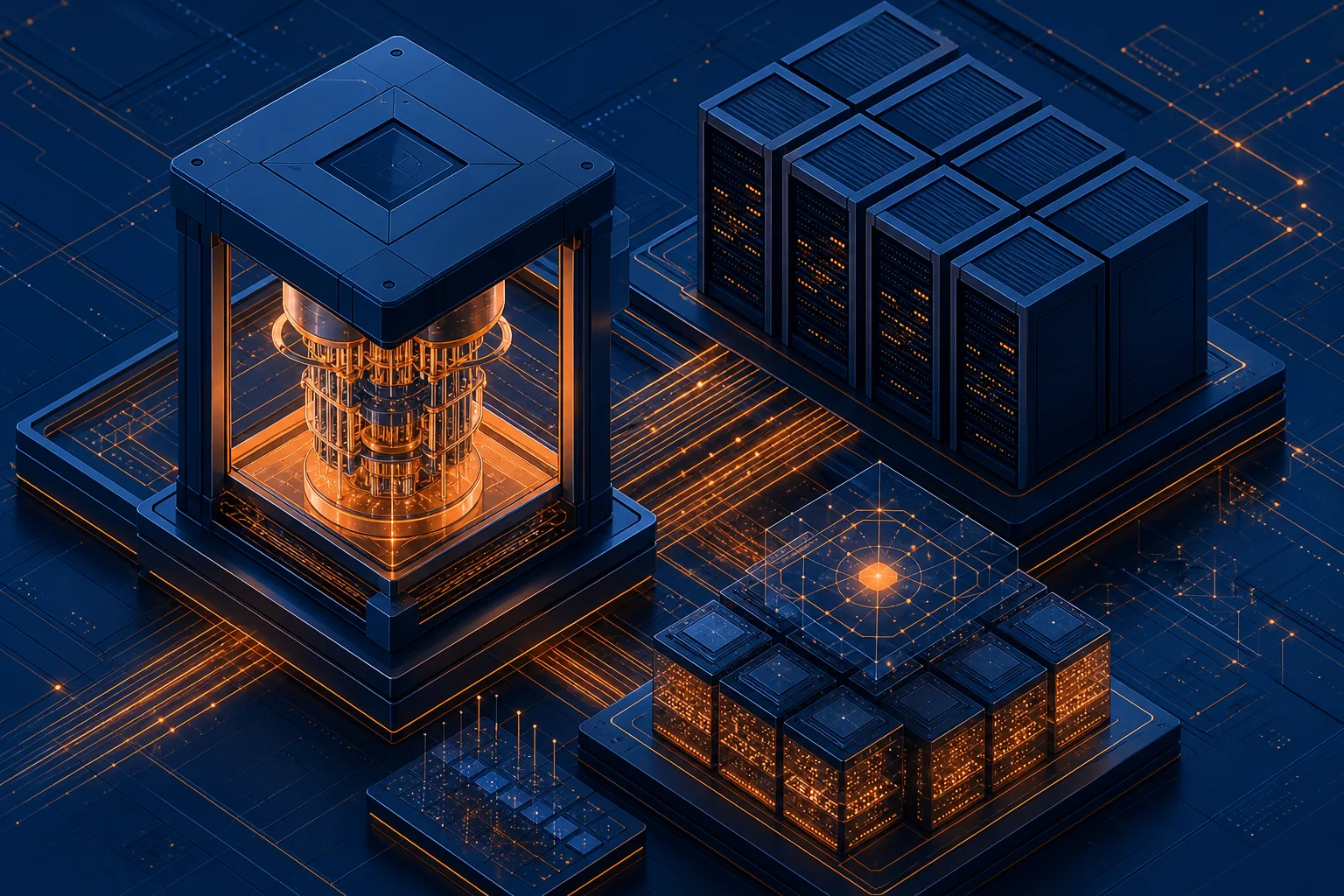
Oak Ridge National Laboratory has activated a specialized co-design platform designed to address the persistent bottleneck of quantum error correction. This infrastructure merges IBM quantum hardware with a classical high-performance computing cluster, creating a unified environment for testing the stability of fragile quantum states.
The Quantum Science Center at the laboratory, supported by the US Department of Energy, oversees the integration of these disparate computing architectures. Researchers aim to mitigate environmental noise, which currently degrades quantum information before complex calculations can reach completion.
At the core of the system sits an IBM Quantum System Two, featuring the 120-qubit Nighthawk r2 processor. This unit represents a significant step in hardware density, though it remains highly susceptible to the decoherence issues that plague current-generation superconducting circuits.
The system operates in tandem with Umbra, a classical supercomputer built on 5th Gen AMD Epyc CPUs and Instinct MI355X GPU accelerators. These GPUs are tasked with the heavy lifting of simulation and optimization, providing the parallel processing power required to manage the massive datasets generated by quantum-classical workflows.
AMD Versal SoCs manage the low-latency control and decoding signals required to maintain the quantum circuitry during operation. These chips are essential for the rapid feedback loops needed to detect and correct errors in real-time, effectively bridging the gap between the quantum processor and the classical control plane.
The integration of these SoCs addresses the critical latency constraints that often derail error correction attempts by ensuring that the classical control hardware can process quantum state data within the strict timing windows required for coherence. By offloading the complex decoding logic to specialized hardware, the system minimizes the time between error detection and the application of corrective pulses to the qubits, which is vital for maintaining the integrity of long-running computations.
Travis Humble, director of the Quantum Science Center, emphasized that refining error correction remains the primary requirement for transitioning quantum systems from experimental curiosities to functional scientific tools. The platform provides the necessary compute density to simulate and optimize these processes in real-time.
Jay Gambetta, IBM Fellow and director of IBM Research, noted that the industry has shifted its focus from proving the viability of error correction to scaling its implementation. The platform enables the evaluation of diverse software workflows and hardware architectures to identify the most efficient paths toward fault tolerance.
The system is currently configured to explore hierarchical error correction, a method that employs nested coding layers to protect logical qubits. This approach utilizes an inner code for local protection, while an outer code provides a secondary layer of redundancy across the system.
IBM research suggests that this hierarchical structure could theoretically achieve a trillion logical operations with a physical error rate of one in a thousand. The heavy reliance on classical compute for these calculations necessitates the high-bandwidth, low-latency connection provided by the integrated GPU and SoC architecture.
This deployment aligns with the objectives of the Department of Energy’s Quantum Genesis Mission, which seeks to field a system capable of executing hundreds of millions of fault-tolerant operations. The initiative serves as a technical foundation for broader federal mandates aimed at achieving functional quantum systems by 2028.
The platform functions as a proving ground for quantum-centric supercomputing, where QPUs, CPUs, and GPUs operate as a single, cohesive unit. By centralizing these resources, the laboratory allows researchers to iterate on algorithms that were previously constrained by the latency of off-site or decoupled classical processing.
Future development will focus on validating these workflows against the specific requirements of the Q Competition. Success in this area will determine how effectively the laboratory can scale logical qubit counts while maintaining the fidelity required for complex scientific discovery.