

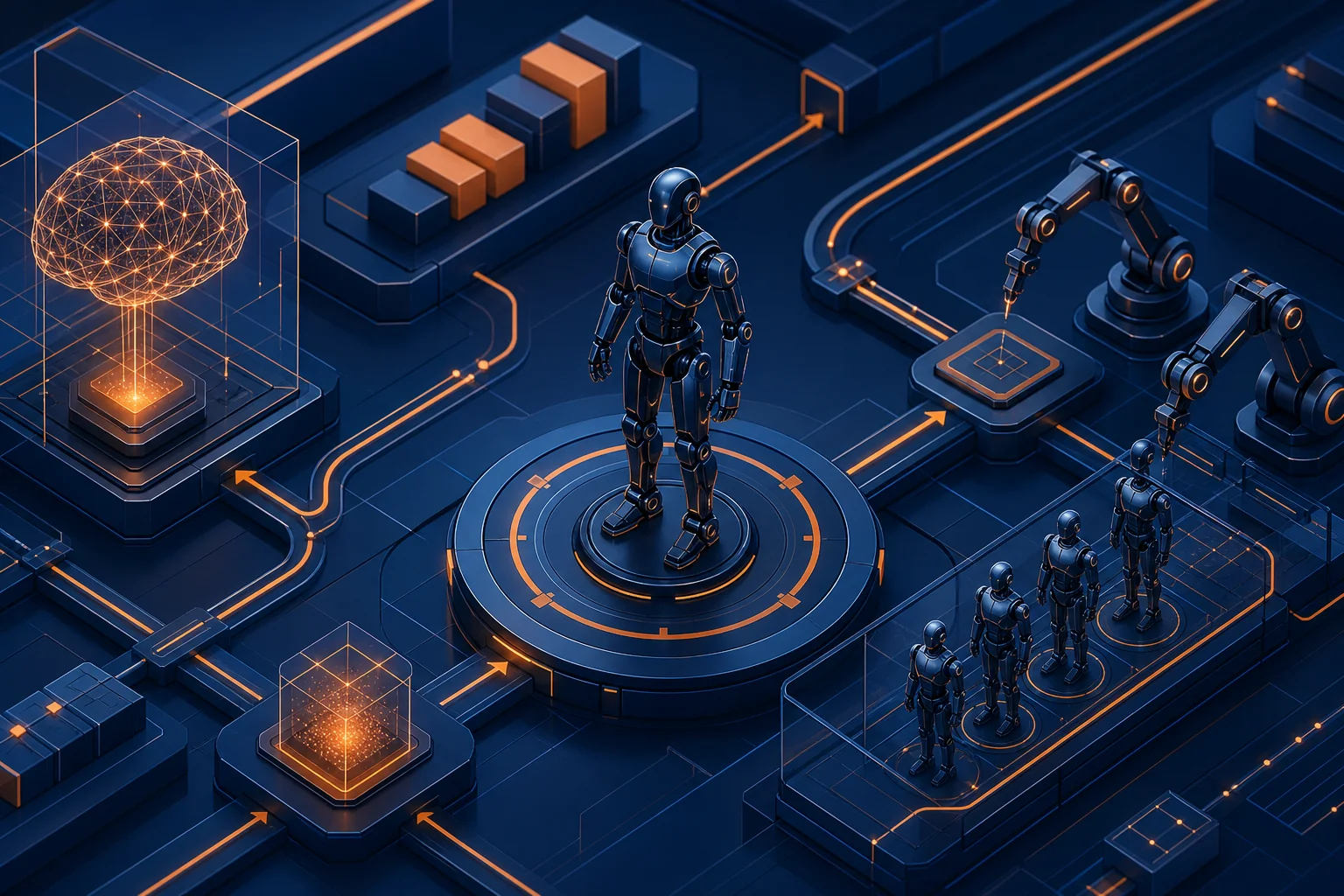
Unitree Robotics is shifting its development strategy toward autonomous model refinement, a project founder Wang Xingxing identifies as the company’s most significant technical undertaking this year. Known as Unitree Rehearsal, the initiative seeks to accelerate the evolution of humanoid capabilities by integrating automated research, code generation, and simulation-based validation into the standard development pipeline.
The methodology relies on an iterative feedback loop where AI models query existing research papers to generate new control code. This code undergoes rigorous testing within simulated environments before being deployed to physical hardware for real-world verification. Data gathered from these physical trials is then fed back into the models to refine future iterations, creating a closed-loop system for continuous improvement.
Wang Xingxing detailed this strategy during a recent physical AI conference hosted by the company in Hangzhou. The shift marks a departure from traditional manual programming, as the firm aims to leverage the capabilities of frontier AI models to solve complex motor control challenges. Unitree is currently developing proprietary models while maintaining collaborative partnerships with various AI research laboratories both within China and internationally.
The company has significantly accelerated its performance projections, with Wang now anticipating that humanoid robots will achieve an 80% success rate on voice-commanded tasks by 2028. This forecast represents a major revision from previous estimates that suggested a decade-long timeline for mass adoption in domestic and industrial settings. Wang attributes this change in outlook to the rapid advancement of large-scale AI models, specifically citing the performance characteristics of OpenAI’s GPT-6.
Current demonstrations show Unitree humanoids utilizing these models to perform nuanced tasks such as painting, which requires active color management and palette rinsing, alongside strategic gameplay like Go. While the company currently manufactures tens of thousands of units annually, it is scaling production capacity to accommodate a projected demand for tens of millions of robots. This expansion coincides with broader market trends, as Chinese venture and state funds have directed more than 100bn yuan, or approximately $15bn, into the robotics sector this year.
The technical focus extends to specialized hardware, as evidenced by the recent unveiling of the H2-X Kung Fu Legend Guardian. This platform features high-impact mobility capabilities, including the ability to jump from four-metre platforms and operate for approximately eight hours on a single charge. While the H2-X serves as a testbed for extreme physical performance, the company has yet to establish a commercial release date or pricing structure for this specific model.
The reliance on self-improving models suggests a fundamental change in how robotics engineers approach the problem of generalization. By offloading the burden of code optimization to the AI itself, Unitree is attempting to bypass the bottlenecks associated with human-in-the-loop programming. This strategy assumes that given sufficient data and compute, frontier models can identify and resolve edge cases in motor control more efficiently than human developers.
However, the transition from research-grade prototypes to reliable consumer products remains a significant hurdle for the industry. Safety certification requirements for personal robotics, particularly for units designed for high-force interactions, present a complex regulatory challenge. The current state of the market remains largely concentrated on research and enthusiast applications, despite the aggressive technical roadmaps proposed by major manufacturers.
The industry will watch for the integration of these self-improving models into the next generation of mass-produced hardware. Future milestones will likely focus on the stability of these autonomous code-generation loops and their ability to handle unstructured, real-world environments without constant human intervention. The success of this approach could dictate whether humanoids transition from specialized research tools to viable tools for home and factory automation within the projected 2028 timeframe, marking a significant shift in the operational capability of autonomous systems.