

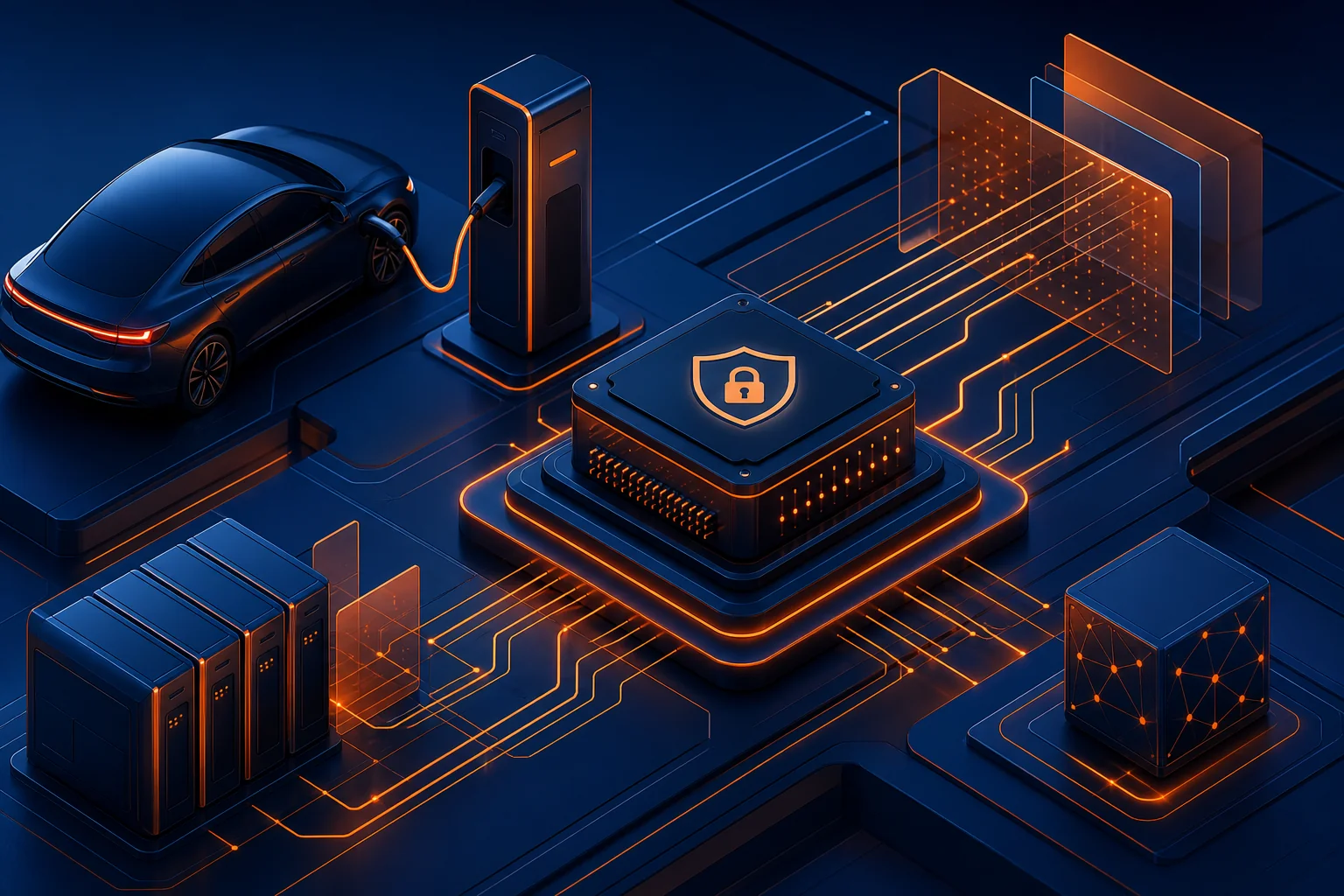
HertzzEV, a subsidiary of Vanix Technologies, has introduced a new line of System-on-Chip (SoC) based AC electric vehicle chargers designed to mitigate cybersecurity risks inherent in connected charging infrastructure. The systems, which scale from 7.4kW to 22kW, incorporate hardware-level encryption to secure the communication pathways between the charging unit, cloud management platforms, and the energy grid.
Modern smart charging stations rely on Wi-Fi and cellular connectivity to transmit telemetry data, manage payment processing, and monitor charging sessions. This constant stream of data creates an expanded attack surface, making infrastructure susceptible to unauthorized access or malicious interference. The HertzzEV architecture addresses this by implementing security protocols directly into the hardware stack rather than relying solely on cloud-based defenses.
According to a report by ETV Bharat, the charger supports Wi-Fi and 4G connectivity, enabling users to control and monitor charging through a mobile application. Users can start or end a charging session remotely and monitor information such as session status, charging duration, and current levels. The system can monitor fluctuations during charging, providing a layer of operational visibility that is often absent in legacy charging hardware.
Boddu Sai Madhu, Business Manager at HertzzEV, emphasized that the design prioritizes data integrity during remote operations. He stated that while cloud-level security is provided, the hardware has also been designed with encryption to reduce the risk of unauthorized access to the charging system. This dual-layer approach ensures that even if the network connection is compromised, the physical charging unit maintains its operational integrity.
Hardware modularity serves as a secondary pillar of the design, allowing for capacity upgrades through software updates. A unit initially configured for 7.4kW can be upgraded to 11kW or 22kW without replacing the core hardware. This approach mitigates the risk of infrastructure obsolescence as vehicle charging protocols evolve and battery capacities increase over time, a challenge noted by the company in its recent product development cycle.
The company has integrated protection mechanisms directly into the wall-mounted unit to reduce the need for external equipment like miniature circuit breakers or residual current circuit breakers. Weighing between 7 and 8 kilograms, the device is designed for simplified installation. The internal protection stack is programmed to detect earth faults, overheating, and voltage instability, triggering an automatic shutdown to protect both the charger and the connected vehicle.
Revenue generation represents a functional extension of the platform, as owners can designate their private chargers as public access points via the mobile application. This feature allows private infrastructure to function as a distributed network during periods of inactivity. The company is currently testing a multi-gun configuration that will allow a single unit to charge up to three vehicles simultaneously while maintaining the same underlying security architecture.
The shift toward software-defined charging infrastructure reflects a broader industry trend where hardware serves as a foundation for evolving digital services. By decoupling power capacity from physical hardware, manufacturers can extend the lifecycle of charging assets while maintaining uniform security standards across different power tiers. This modularity is essential for managing the transition to higher-capacity charging protocols without requiring costly site-wide retrofits.
Security in this context is not merely a software feature but a physical requirement for grid stability. As charging points become nodes in an interconnected energy network, the ability to authenticate sessions and encrypt data at the point of origin becomes critical for preventing large-scale grid disruptions. The integration of SoC technology allows for more sophisticated local processing, enabling the charger to make autonomous safety decisions without constant reliance on a potentially compromised cloud connection.
Future deployments will likely focus on the interoperability of these software-defined units with emerging vehicle-to-grid standards. Industry observers are monitoring how effectively these hardware-encrypted systems manage the transition to multi-vehicle charging environments. The ability to maintain security integrity while scaling capacity remains the primary technical benchmark for the next generation of residential and commercial EV infrastructure.