

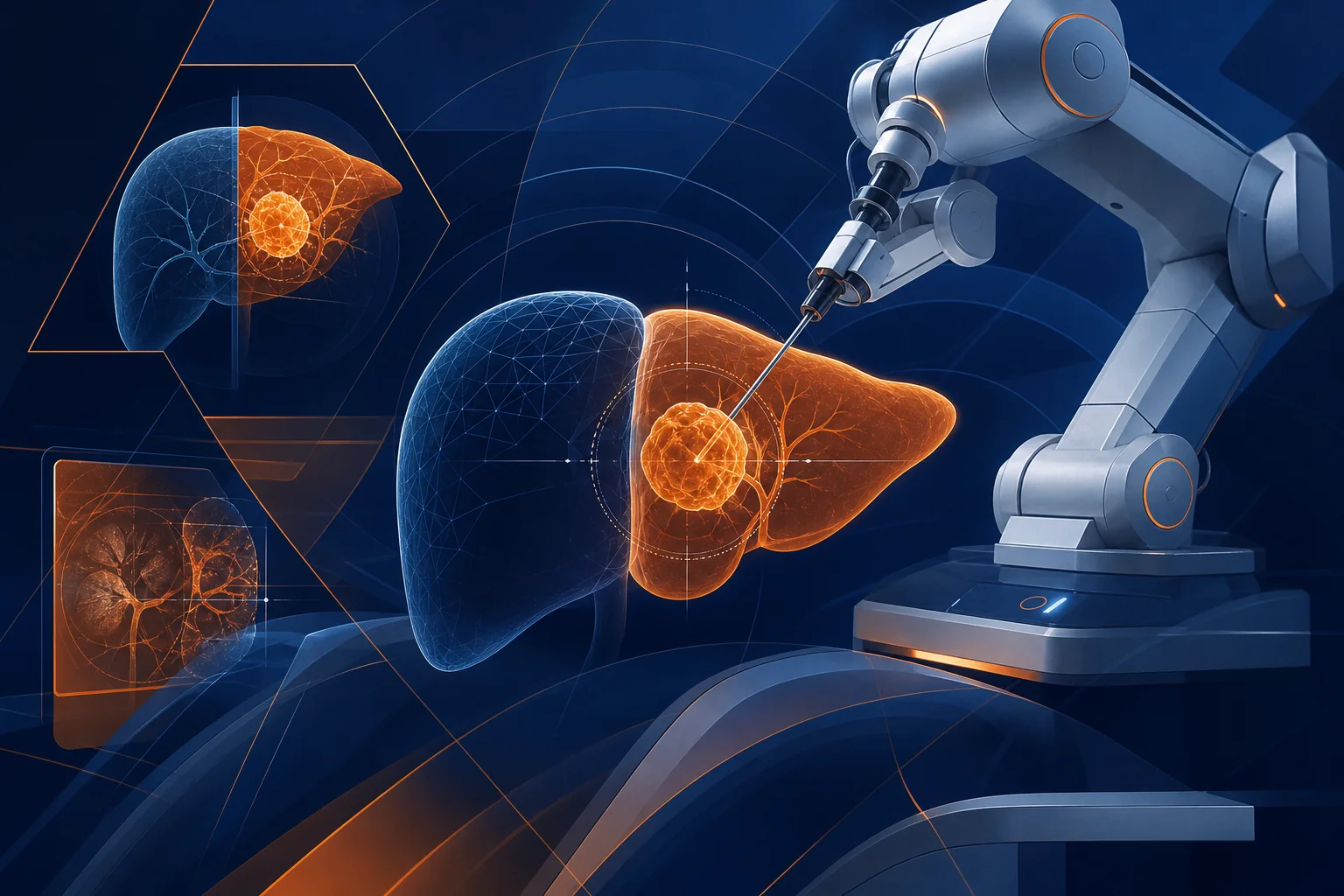
Precision IO Group is set to debut significant technical enhancements for its Epione robotic ablation platform at the CIRSE 2026 congress in Copenhagen, running from September 5 to September 9. The updates focus on automating the segmentation of liver tumors and establishing interoperability between the Epione system and GE HealthCare’s Allia Moveo Interact Touch panel.
The centerpiece of the software update is the introduction of Smart Seg AI, a deep-learning tool designed to replace the manual contouring of liver tumors. This tool utilizes a model trained on thousands of computed tomography scans to identify and delineate target areas automatically, a process that traditionally requires significant time from interventional radiologists.
By automating the segmentation phase, the system aims to mitigate the variability inherent in manual contouring while accelerating pre-procedural planning. This capability complements the existing Epione platform, which currently manages planning, targeting, delivery, and confirmation for percutaneous ablation procedures across abdominal, chest, and musculoskeletal regions.
The integration with GE HealthCare’s Allia Moveo Interact Touch panel represents a move toward hardware-software convergence in the interventional suite. This pairing allows clinicians to manage 3D imaging, treatment planning, and robotic needle guidance from a single interface, eliminating the need to switch between disparate workstations during time-sensitive procedures.
Technical engineers at Precision IO have optimized the communication protocol between the Epione robot and the Allia Moveo system to ensure low-latency data exchange. This synchronization allows the robotic needle guidance to reflect real-time imaging updates directly on the touch panel, providing a cohesive visual feedback loop for the surgeon.
Kurt Azarbarzin, CEO of Precision IO Group, stated that the collaboration reflects a shared commitment to advancing image-guided interventions. He noted that the flexibility of the Epione platform enabled a direct integration with the Allia Moveo interface, allowing physicians to maintain focus on the patient during complex interventions.
Technical demonstrations are scheduled at the GE HealthCare booth on September 6 and September 7 to showcase the unified workflow. Additionally, Yann Le Meur, Director of Innovation & Technology at Quantum Surgical, will discuss the mechanics of human-machine collaboration in interventional oncology during the SPHAIRE lecture series on September 8.
The Epione platform currently holds CE marking for abdominal, chest, and musculoskeletal indications using CT and CBCT guidance. In the United States, the system maintains FDA clearance for abdominal ablation, while musculoskeletal applications are currently limited to an ongoing investigational device exemption clinical study.
The shift toward automated segmentation addresses a fundamental bottleneck in interventional oncology where manual contouring remains a repetitive and time-consuming task. By offloading these calculations to a deep-learning agent, the system reduces the cognitive load on radiologists and standardizes the definition of tumor boundaries across different clinical environments.
Consolidating the control interface into the angiography system’s touch panel further minimizes the physical and digital friction experienced by the surgical team. Reducing the number of interaction points between the robotic guidance system and the imaging hardware is expected to lower the probability of targeting errors during needle placement.
These technical advancements signal a broader trend toward the integration of AI-driven automation within the surgical theater to improve procedural safety and patient throughput. As hospitals face increasing pressure to manage higher volumes of ablation services, the ability to streamline these workflows through unified interfaces and automated image processing becomes a critical operational requirement.
Future watchpoints include the expansion of the Epione platform’s regulatory clearance for musculoskeletal applications in the United States and the potential adoption of Smart Seg AI in other clinical indications. The performance of these AI agents in high-volume, real-world hospital settings will determine the long-term viability of fully automated segmentation in routine interventional practice.